Solar Street Lighting for South Africa: Load-Shedding Proof
Every load-shedding stage that kills a grid street light is completely irrelevant to a solar one. But getting the spec right — autonomy, battery chemistry, IP rating for the highveld — is the difference between a road that stays lit and one that doesn't.
The road your client drives home on goes dark at Stage 4. The municipal street lights are grid-fed, and when Eskom cuts the suburb's allocation, the lights go with it. In the morning, the cable that ran along the verge is gone — stripped overnight while nobody could see. The repair bill lands on the municipality. The road stays dark for another three months.
That's not a hypothetical. It's the operating reality for road lighting across South Africa. The good news: every part of that problem disappears the moment you switch to solar. Here's how to spec it correctly.
1. Load-shedding is a non-issue — if the battery is sized right
A solar street light draws zero power from the grid. Load-shedding at Stage 2, Stage 6 or beyond changes nothing for a solar-powered road. The light charges from the sun during the day and runs on its battery at night — Eskom's schedule is simply irrelevant.
The critical spec is battery autonomy: how many consecutive cloudy nights the light runs without a full recharge. For South African conditions, specify a minimum of 2–3 nights' autonomy. Johannesburg and the highveld have reliable summer sun but overcast winters; Cape Town's winters bring sustained cloud cover for days at a stretch. Size the battery for the worst week of your installation's worst season, not the average day.
2. Cable theft disappears as a problem
South Africa loses significant value annually to copper cable theft — infrastructure cables, transformer windings, and the armoured cables that feed grid street lights. Solar street lights eliminate this vulnerability entirely. Each unit is self-contained: panel, battery, LED and controller in a single housing on the pole. There is no buried cable to cut, no copper to strip, and no dark road left behind when a thief works the verge at 2am.
For estates, townships and municipal roads where theft has been a recurring cost, this is often the single most compelling argument for solar — not the electricity saving, but the zero cable-theft exposure.
3. Choose LiFePO4 — the highveld will destroy anything else
Battery choice matters more in South Africa than in most markets. The Gauteng highveld regularly pushes above 35°C in summer; a pole-mounted housing in direct sun can reach significantly higher. Cheap lithium-ion and lead-acid batteries degrade rapidly under sustained heat — you'll see 30–40% capacity loss within two years, which means the lights start failing early in the night long before the battery is "dead."
LiFePO4 (lithium iron phosphate) handles heat fundamentally better, delivers 2,000+ full charge cycles, and holds capacity for the design life of the luminaire. For a road lighting project where you're quoting a 5–10 year maintenance-light lifespan, LiFePO4 is the only battery chemistry worth specifying. Insist on it in every quotation and verify it in the datasheet.
4. IP66 minimum — dust, rain and highveld storms
South African conditions test luminaire sealing from multiple directions: summer highveld thunderstorms that drop 50mm of rain in an hour, dust from unpaved access roads in dry provinces, and coastal salt air in KwaZulu-Natal and the Western Cape. IP65 is adequate for sheltered positions; for exposed road or perimeter installations, specify IP66 — dust-tight and rated for high-pressure water jets. Here's how IP ratings compare in practice.
5. All-in-one vs split: which suits South African roads
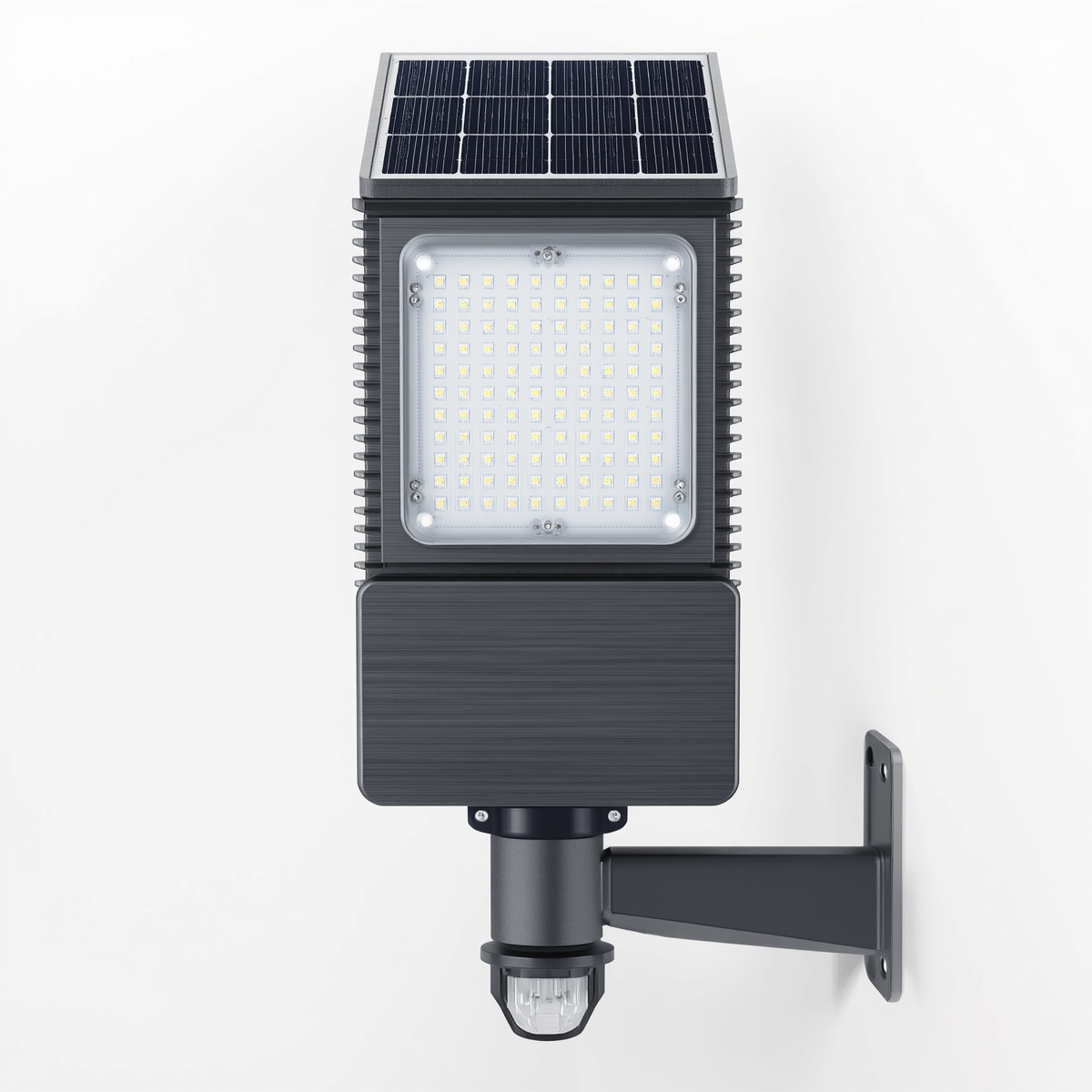
For the vast majority of South African road and estate installations, an all-in-one solar street light is the right choice. Everything is integrated in one housing — fastest to install, no external panel to vandalism-target, and no cable run between panel and lamp that could be cut. The 100W–300W range covers residential streets through main roads.
A split system (panel on the pole arm, head separately) makes sense only where shading from trees or adjacent buildings prevents the integrated panel from charging properly. On open South African roads, that's rarely the constraint.
6. What to ask for in a quotation
When you're sourcing solar street lights for South Africa, these are the non-negotiables to confirm before placing an order:
- Battery chemistry: LiFePO4 explicitly stated — not "lithium" or "li-ion"
- Autonomy: 2–3 nights at your target output level, confirmed in the datasheet
- IP rating: IP65 minimum, IP66 for exposed installations
- Operating temperature range: should cover at least –10°C to +50°C for highveld and Karoo conditions
- Certifications: CE + RoHS — required for customs clearance and procurement compliance
- Radar motion sensing: dims between vehicles to extend battery runtime through long winter nights and extends autonomy through cloudy periods
A supplier who can't provide datasheets confirming all of the above upfront is a supplier worth avoiding — the spec that isn't confirmed before shipment is the spec that causes a site visit six months later.