PIR vs Radar Motion Sensors for Solar Lights
Most solar security and street lights trigger on one of two sensor types — PIR or radar. They behave very differently, and picking the wrong one means false alarms, missed detections or flat batteries. Here's how to choose.
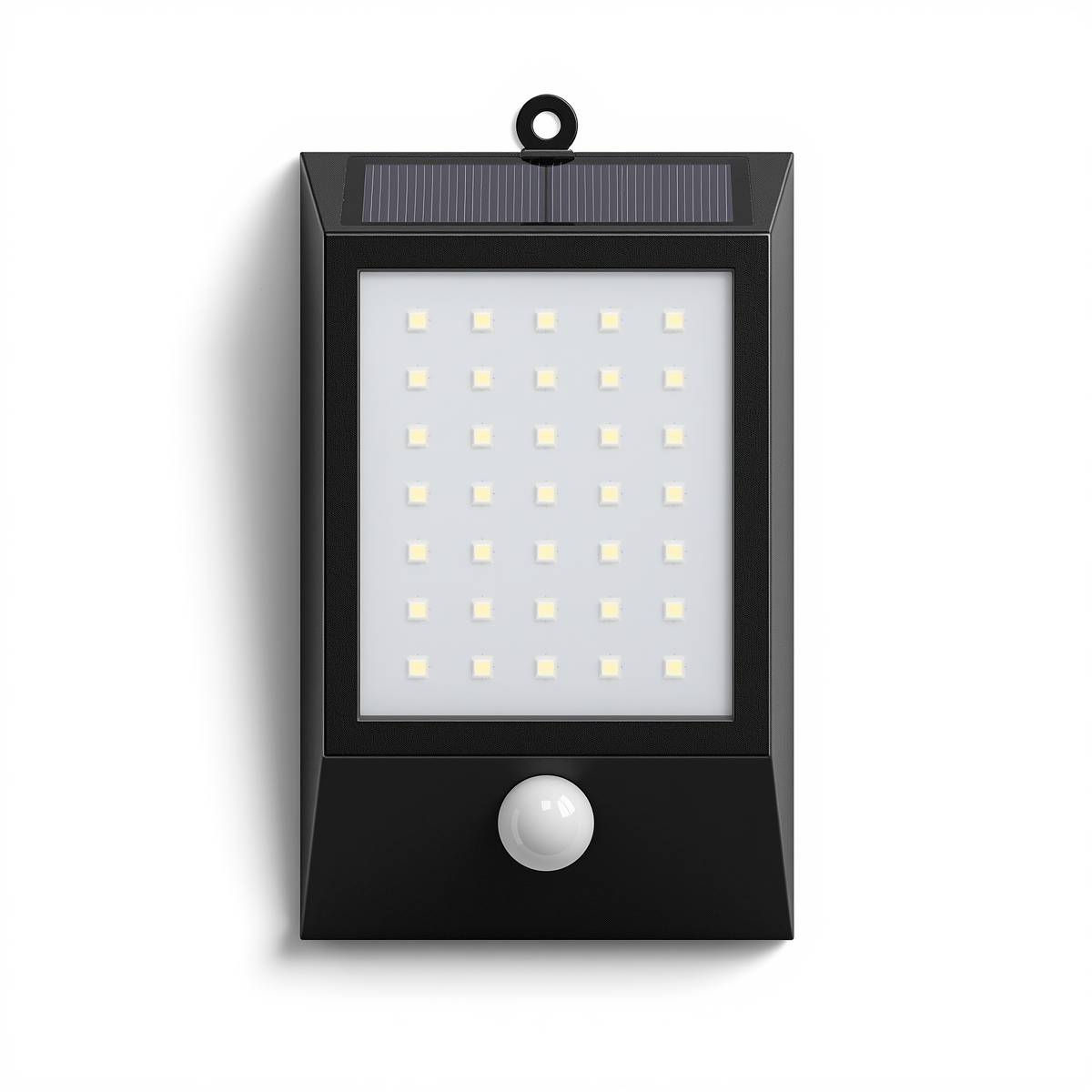
A motion-activated solar light is only as good as its sensor. Two technologies dominate the market — PIR (passive infrared) and radar (microwave/Doppler) — and they suit different jobs. Understanding the difference lets you spec lights that trigger when they should, ignore what they shouldn't, and stretch the battery through long nights.
How PIR (passive infrared) works
A PIR sensor is passive: it doesn't emit anything, it simply detects the infrared heat radiating from a moving body — a person, an animal, a vehicle engine. When that heat signature crosses the sensor's field, the light triggers. PIR is the standard on wall and flood units like our PIR motion sensor wall light and 3-head motion flood light.
Strengths: very low power draw (good for battery life), reliable triggering on warm bodies, and strong resistance to false alarms from wind, rain or moving foliage. Limits: shorter range (typically 8–12 m), needs a clear line of sight, can't see through walls or glass, and its sensitivity can drop when the ambient temperature is close to body temperature.
How radar (microwave) works
A radar sensor is active: it emits low-power microwaves and measures the reflected signal, detecting motion from the frequency shift (the Doppler effect). It senses any movement, not just heat. Radar is the standard on street lights like our all-in-one solar street light and split solar street light.
Strengths: longer detection range, a wide adjustable field, the ability to sense through thin non-metal covers (so the sensor can be sealed inside the housing), and consistent performance in hot climates where PIR struggles. Limits: higher power draw than PIR, and — if poorly tuned — it can over-trigger on movement you don't care about.
PIR vs radar at a glance
| PIR (passive infrared) | Radar (microwave) | |
|---|---|---|
| Detects | Body heat in motion | Any motion (Doppler) |
| Typical range | 8–12 m | Longer, wide & adjustable |
| Power use | Very low | Higher |
| False alarms | Low | Needs tuning |
| Through covers | No | Yes (thin, non-metal) |
| Hot climates | Sensitivity can drop | Unaffected |
| Best for | Walls, gates, perimeters | Streets, roads, large areas |
Which sensor for which job
Perimeter security — choose PIR. For boundary walls, gates, driveways and yards, PIR gives reliable person-and-vehicle triggering with minimal false alarms and the lowest battery cost. It's the right call for residential and commercial security.
Streets and large areas — choose radar. For roads, car parks, campuses and warehouse yards, radar's longer range and wide field cover the space, and it pairs naturally with dimming. See our street-light buyer's guide for full sizing.
The hidden benefit: radar dimming saves battery
Radar's real advantage on street lighting isn't just range — it's dim-to-bright control. The light holds a low standby level and jumps to full output only when the sensor detects a vehicle or pedestrian. This can cut nightly energy use dramatically, which directly extends autonomy through winter and cloudy spells. Here's why that matters for cold-climate performance.
What to ask your supplier
Spec the sensor, not just the lumens: Which sensor type — PIR or radar? What is the detection range and angle? Is sensitivity and hold-time adjustable? Does it support dim-to-bright? A supplier who can answer for each model is one who actually understands the application. JC Lightning specs PIR on flood and wall units and radar on street lights, and tunes both for your market on OEM orders.