What Is Solar Lighting?
A self-contained outdoor lighting system that captures sunlight by day and runs all night — no grid, no wiring, no electricity bill.
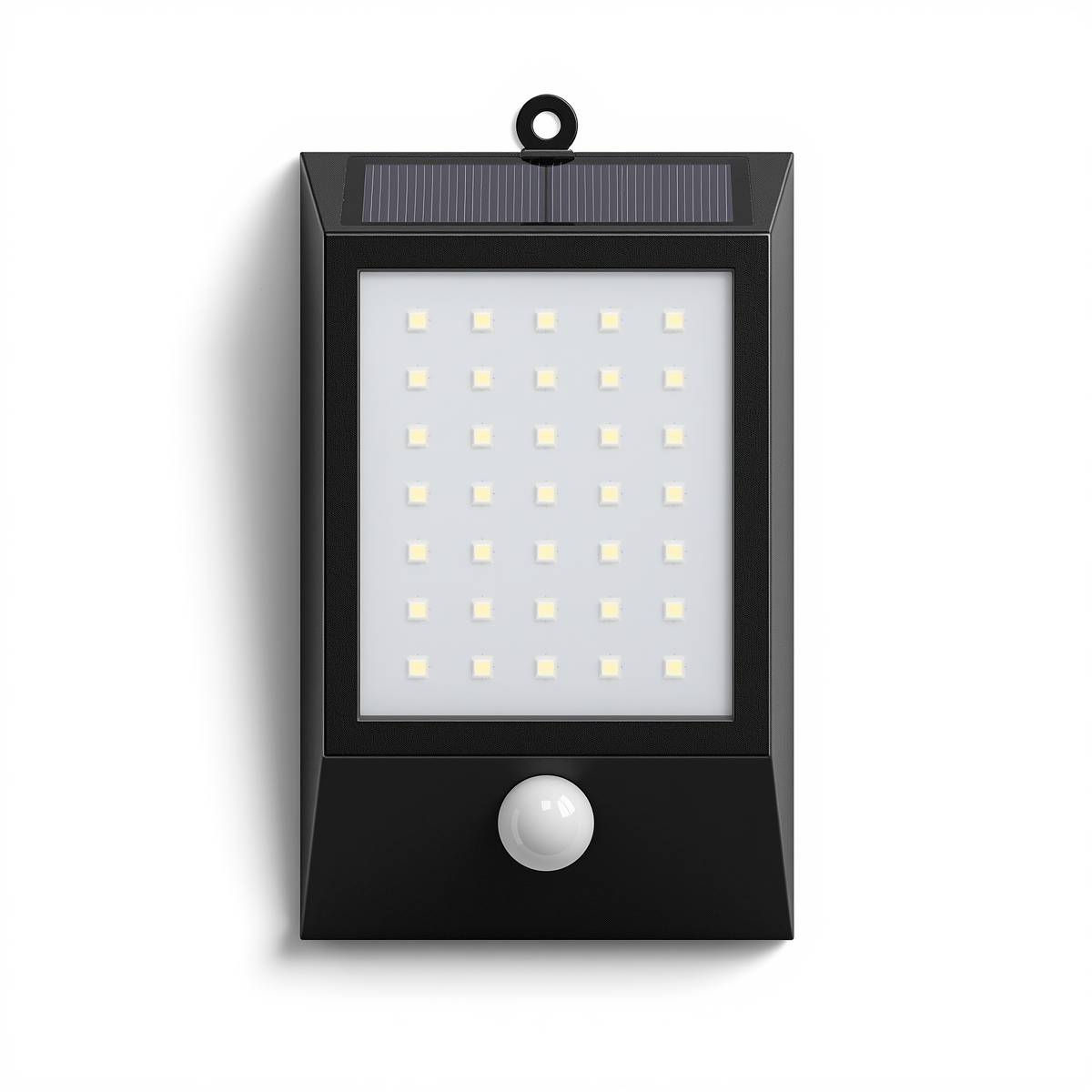
Your client needs a forecourt lit, a perimeter secured, or a road illuminated — and the grid connection is either too far away, too expensive to run cable to, or too unreliable to depend on. Solar lighting solves that problem with a product that ships as a single unit, mounts to a wall or pole in under an hour, and draws nothing from the grid for its entire life.
The Basic Definition
Solar lighting is an off-grid lighting system that converts sunlight into electricity during the day, stores that electricity in an onboard battery, and uses it to power an LED light at night. The entire system — panel, charge controller, battery, LED, and sensor — is contained in a single weatherproof fixture.
Unlike conventional outdoor lighting, which requires a permanent connection to the electrical grid via buried cables, solar fixtures operate independently. The grid can be miles away, unreliable, or completely absent. The solar fixture doesn't notice. During daylight hours, the panel charges the battery. At dusk, an ambient light sensor switches the LED on. At dawn, the sensor switches it off and the cycle begins again.
Main Types of Solar Lighting
The category has expanded significantly over the past decade. What was once a niche of small garden ornaments now covers serious infrastructure products across four segments:
Security and Flood Lighting
Solar security lights — motion-activated PIR floodlights, wall-mount sconces, and all-in-one street lights — are the highest-volume segment. Output ranges from 600 lm (entry residential) to 3,500 lm (commercial perimeter) and above. PIR sensors trigger full-brightness bursts when motion is detected, extending battery runtime by keeping the light at low power between activations. The primary markets are Southern Africa (load-shedding), West Africa, and Latin America.
Garden and Landscape Lighting
Solar path lights, spike spotlights, bollard lights, and deck step lights serve residential gardens, resort landscaping, and property developers. Output is lower (50–500 lm) since the function is atmosphere and wayfinding rather than security. IP67-rated models for ground-flush and pool-perimeter installation are a growing sub-category.
Street and Road Lighting
All-in-one solar street lights integrate a large panel, radar sensor, and high-capacity LiFePO4 battery in a single pole-mounted unit. Output: 5,000–30,000 lm depending on wattage (100–300W). Used for rural roads, estate driveways, commercial car parks, and public infrastructure projects in regions where grid extension is cost-prohibitive.
Decorative and Specialty
Solar wall lanterns (hybrid solar/AC), Edison string lights, and garden stake sets occupy the decorative end of the range. These products trade raw lumen output for aesthetics and retail price positioning. Increasingly stocked by garden centres, hardware chains, and online retailers targeting the lifestyle segment.
Solar vs Grid-Tied: The Core Differences
| Factor | Solar lighting | Grid-tied lighting |
|---|---|---|
| Power source | Onboard battery, charged by solar panel | Continuous grid supply |
| Installation | Wall/pole mount, no cabling | Trenching, cable runs, electrician |
| Blackout resilience | Operates normally | Off during outages |
| Running cost | Zero electricity cost | Monthly tariff per fixture |
| Off-grid sites | No restriction | Requires grid access |
| Upfront cost | Higher per fixture | Lower fixture, higher install |
Key Specifications to Understand
When evaluating solar lighting products, these are the numbers that actually determine performance:
- Lumen output (lm): Actual brightness. 800 lm is adequate for a porch or garden path; 2,500+ lm is needed for perimeter security; 10,000+ lm for street lighting.
- Battery capacity (mAh/Wh): Determines how many hours the light runs on a single charge. Match capacity to expected night length and any load-shedding reserve needed.
- Battery chemistry: LiFePO4 for hot climates and long service life. Standard Li-ion for mild climates only.
- IP rating: IP65 minimum for any outdoor fixture; IP66 for security/street lights; IP67 for ground-mounted or pool-perimeter fixtures.
- Sensor type: PIR (motion, 8–12m) for security activation; radar for vehicle detection; photoresistor for dusk-to-dawn operation.
- Panel wattage: Should be sized to fully recharge the battery on a typical day for the target latitude — under-sized panels result in chronic partial charging and shortened battery life.
Who Buys Solar Lighting?
The B2B market for solar lighting is broader than it might appear. Beyond the obvious residential distribution channel, solar lighting is regularly specified and purchased by:
- Property developers fitting out residential estates, hotels, and commercial parks where lighting infrastructure cost is a line item
- Security companies specifying perimeter lighting for client sites
- Government and NGO procurement for rural roads, border infrastructure, and community lighting projects
- Telecom tower operators needing reliable off-grid lighting at unmanned sites
- Agricultural businesses lighting remote storage, processing, and livestock facilities